Kingston Blue Mountains Tour with Coffee Tasting
Hotel pickupFarm entryCoffee tasting
From $90 per person
The harvest runs to its own calendar rather than to a timetable. It changes what a visit looks like more than the weather does. This page is the farm's year from the farm's side: who is on the slope, what they are doing, and what happens to the crop the same night.
Picking runs from roughly late August or September into January. The higher farms come in later than the lower ones, because cherries ripen more slowly the further up you go. That spread is why the season reads differently depending on which grower you ask. A farm at 3,200 feet and one at 4,800 feet work a month apart on the same mountain.
Come inside that window and the slope is busy: bags, ladders, and a queue at the weighing station in the afternoon. Come outside it and you get a quiet green hillside and a guide with time to talk. That is not the worse morning of the two.
Cool nights and afternoon cloud slow the fruit down. The same variety planted near the coast finishes months earlier. At 3,000 to 5,500 feet the cherry hangs on the branch far longer, and the trees on one plot do not finish together. The result is a long, ragged season that cannot be mechanised and has to be walked.
Flowering follows the first proper rains, usually in February and March. The trees put out dense white blossom that smells of jasmine and lasts a few days at a time, in waves rather than all at once. It is the prettiest the farms look all year, and almost nobody plans a trip around it.
Each wave of blossom becomes a wave of cherry. That is the other half of why the picking season is so long. If your dates fall in late February, ask the operator whether the trees are in flower. A local guide knows that to the week.
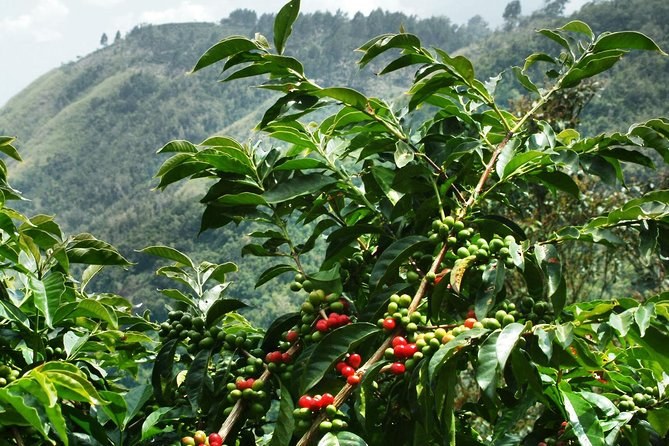
A picker takes only the deep-red cherries and leaves the rest to ripen, then returns to the same tree a fortnight or so later, and again after that. Four passes over one tree across a season is normal. Pay is by volume, the box being the unit, so a picker's day is a judgement about which trees are worth walking to.
A guided walk makes that concrete. Stand next to a branch carrying green, yellow and red at once and selective picking explains itself. It is one good reason to time a Blue Mountains Jamaica coffee tour for the autumn if you have the choice.
Everything picked has to be pulped within hours, so the processing yard works in the evening and the tanks are filled by dark. Washing follows the next morning. The beans then go out on the drying barbecues for the better part of a week, raked through the day and covered before the afternoon rain.
Visit in October or November and this is the part you smell before you see it. Wet parchment drying in the sun has a particular sweet-sour smell that nothing else does. The full chain is on the processing page.
Between February and August the trees are flowering, setting or filling. The work is pruning, weeding and the endless business of keeping a steep slope from washing away. Nothing is missing from a tour in those months: the estate walk, the processing yard and the tasting all run year-round, and the guide has more time for you.
What you lose is the theatre of a working harvest. What you gain is a farm that is not trying to get a crop off a hillside while you stand in the middle of it.
Melissa made landfall in western Jamaica on 28 October 2025 as a Category 5, the strongest storm on record to hit the island. The worst damage was in the west and the south. One operator says on its own listing that Kingston and the Blue Mountains came off comparatively lightly, and that its tours are running.
The crop is another matter. About 40 per cent of the mature 2025/26 crop was lost across St Andrew, Portland and St Thomas, on the order of 100,000 boxes. JACRA completed a $120-million recovery programme in March 2026, distributing seedlings, fertiliser and crop-protection materials across the Blue Mountain and High Mountain regions. A replanting drive followed at Guava Ridge in St Andrew on 9 January 2026.
Windows differ by a few weeks between growers and by altitude; higher farms run later.
| Months | On the tree | On the farm | What a visit shows you |
|---|---|---|---|
| January | The last of the picking, high farms | Drying and hulling | A working yard, and the tail of the harvest |
| February–March | Blossom | Pruning and weeding | White hillsides, and the quietest guides of the year |
| April–June | Green cherry setting | Weeding, soil work | The growing explained rather than watched |
| July–August | Cherries filling and colouring | Preparing the yard | First red on the low farms by late August |
| September–October | Ripe cherry, low to high | Picking and pulping | Pickers on the slope; the yard running at night |
| November–December | Peak picking | Drying barbecues full | The whole chain happening at once |
What the sky is doing in each of those months is on the weather page, and every departure is on Blue Mountain Coffee Tours.
From $90 per person