Blue Mountain Craighton Estate Coffee Tasting Tour / Devon House
PrivateTransport includedAir-conditioned
From $180 per person
Every tour here ends the same way: a cup poured from beans grown on the slope you have just walked. What varies is how formal it is, how much of the process you see first, and whether you get to compare more than one thing. Here is what each version puts in front of you.
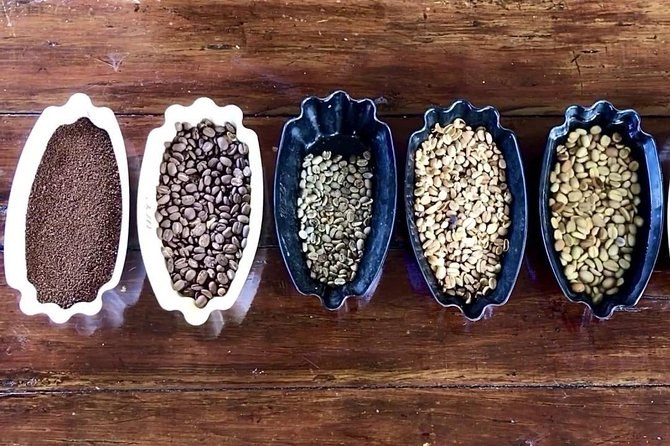
Somewhere between a demonstration and a cupping. A guide takes you through the stages in front of you, usually a set of dishes holding the bean at each point from parchment to roast. Then the coffee is brewed and poured. On the estate tours the person doing it is a certified coffee guide rather than your driver, and one listing says so outright.
It is not a scored session with a spittoon, and nobody will ask you to name the notes. What it is built to show you is why a bean grown at 4,000 feet on this ridge is handled differently from one grown near the coast.
The set-up you will most likely meet lays the bean out in order. It is the clearest thirty seconds of the whole day. Left to right, it usually runs:
Cupping is the industry's standard way of judging a coffee. A measured dose of coarse grounds, hot water poured on top, and a crust that forms and is broken with a spoon. You then taste off that spoon with a sharp slurp.
The slurp is not theatre. It sprays the liquid across the whole palate at once, which is the only way to catch acidity and body in the same mouthful. If you want the full scored session, ask when you book. A small operator will arrange it with notice and cannot conjure it on the morning.
Medium, almost always. A Blue Mountain bean is bought for balance rather than intensity, and a dark roast burns off the thing people pay for. Estates selling into the Japanese market roast lighter still, because that market prizes clarity above body.
Take one practical thing from a tasting and take this: buy the roast date, not the roast level. A bag roasted three weeks ago at any level beats a bag roasted six months ago at your favourite one.
Two different products, and the difference is not the coffee.
Two ways to the same cup. What the fare is really buying on the left is the driver.
| On a guided tour | At the estate gate | |
|---|---|---|
| What it is | The tasting at the end of a farm walk, with a guide | Craighton's own one-hour tour and tasting |
| How long | About an hour to two hours on site | One hour |
| Best for | Anyone without a car, or without the appetite for the road | Anyone already up the mountain with time to spare |
| What it costs | From $90, transport and guide included | US$25 adult, US$15 child 6–12 |
| The catch | The day is four to nine hours door to door | You still have to drive an hour of switchbacks |
“The guide at the farm covered the plant types, the roasts and what actually makes a good brew. Good value and seamlessly organised.” Rochelle, Jamaica, October 2025
Every estate sells beans, and this is the moment most people decide they want some. Nobody publishes a shelf price in advance. So taste first, ask what was roasted and when, and buy the smallest bag that will get you home.
Watch for two things. Green beans travel better than roasted ones, if you have a way to roast them. And a bag labelled Jamaica High Mountain is a good coffee that is not the thing you came up here for. The grading behind both labels is on the processing page.
There is no scheduled public workshop programme on these estates. The guided tasting at the end of a tour is what exists, and it is genuinely good. The nearest thing to a longer session is the Mavis Bank visit, which spends its 45 minutes on the machinery rather than the cup.
If you want more than one estate in a day, the private half-days have the flexibility to do it. Which of them is on Blue Mountain Coffee Tours, and the shape of the day covers the timings.
From $180 per person
From $90 per person
From $180 per person