Kingston Blue Mountains Tour with Coffee Tasting
Hotel pickupFarm entryCoffee tasting
From $90 per person
Almost everything surprising about this coffee comes from one fact, and the rest are consequences of it. Here are thirteen, all checkable, most of them contradicting something a visitor assumes on the way up.
Under the Coffee Industry Regulation Act, only coffee grown in St Andrew, St Thomas, Portland and St Mary may be sold as Jamaica Blue Mountain. Everything else about it follows from that boundary.
The Jamaica Tourist Board publishes the band as 3,000 to 5,500 feet. Below 3,000 the same farmers' crop must be sold as Jamaica High Mountain. Above 5,500 is forest reserve, and nobody plants there.
A farm at 3,100 feet and one at 2,900 feet can be worked by the same family with the same variety, and they sell into different markets at different prices. The line is administrative and the consequence is entirely commercial.
Over 80 per cent of Jamaica's coffee is exported, and most of that goes to Japan. It is genuinely easier to buy a bag in Tokyo than in a Kingston supermarket, which is why buying at the gate is worth doing while you are standing there.
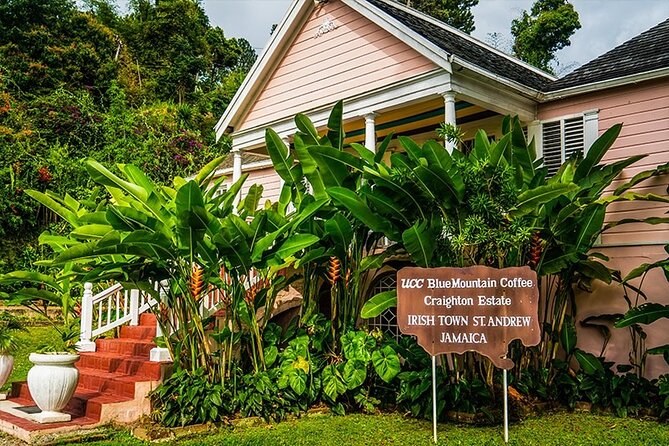
Craighton Estate above Irish Town belongs to UCC, the Ueshima Coffee Company. The Japanese market did not just buy the crop; in places it bought the farm. More on who owns what.
Sir Nicholas Lawes, governor from 1718 to 1722, brought coffee plants from Martinique and had them planted on his property in St Andrew. Nine years later the island exported 83,000 lb.
Cherries on one branch ripen at different times, so a picker takes the deep-red ones and comes back a fortnight later, and again after that. Four passes over one tree in a season is normal. How the harvest works.
Cool nights and daily afternoon cloud slow the fruit down. A longer ripening puts more sugar and more acid into a denser seed, and a denser seed behaves differently in the roaster. That is the whole argument for the altitude rule.
From Kingston the range reads blue rather than green, because distance and moisture scatter the light before it reaches you. Photograph it from the lookout on the way up and you will see why the name stuck.
The Blue and John Crow Mountains went onto the UNESCO list in July 2015: Jamaica's first inscription and the Caribbean's first mixed cultural and natural property, at 26,252 hectares. Above 900 metres, roughly half the flowering plants grow nowhere else.
Part of the case for that listing is human. The forest sheltered Taíno people and then the Windward Maroons, whose descendants still live on the eastern side of the range. What else is up there.
Melissa made landfall in western Jamaica on 28 October 2025 as a Category 5, the strongest storm on record to strike the island. About 40 per cent of the mature 2025/26 crop was lost across St Andrew, Portland and St Thomas.
JACRA completed a $120-million recovery programme in March 2026, distributing seedlings, fertiliser and crop-protection materials across the Blue Mountain and High Mountain regions. A replanting drive followed at Guava Ridge in St Andrew in January 2026.
Three of these facts land differently when you are standing on the slope. The first is the ripe cherry, which is sweet: coffee is a fruit, and almost nobody expects the taste of the flesh around the seed.
The second is the unevenness. One branch carries green, yellow and deep red at the same time, which is the whole reason picking is done by hand in repeated passes. Read that in a paragraph and it is a fact; see it on a branch and it explains the price.
The third is the cold. Kingston runs above 30 °C and the estates are 3,000 feet higher, so the temperature drop between the hotel lobby and the farm gate is the altitude rule made physical. What the day feels like covers the rest of it, including the road.
The estates are open and the tours are running. What is thinner is the crop, and by extension the bag on the shelf: production had already been falling before Melissa, and the 2025/26 season lost roughly 40 per cent of its mature crop across the three main coffee parishes.
That has two practical consequences for a visitor. Prices are unlikely to soften soon, and buying at the gate rather than the airport puts the money where the replanting is happening. JACRA's recovery programme distributed seedlings and inputs across the region in early 2026, and the drive at Guava Ridge in St Andrew was its public face. The harvest page follows the season through.
The parish list is in the Coffee Industry Regulation Act. The elevation band is published by the Jamaica Tourist Board. The World Heritage figures are UNESCO's, the storm figures are the National Hurricane Center's, and the crop and recovery numbers were reported by the Jamaica Information Service and the Jamaica Observer in early 2026.
That matters because a good deal of what circulates about this coffee is marketing. Every figure above is traceable to a body with a reason to get it right, and none of it comes from a tour listing. The farms page carries the same sources where they apply to the estates you can visit.
Sources: the Coffee Industry Regulation Act, the Jamaica Tourist Board, UNESCO, the Jamaica Information Service and NOAA.
| Fact | Figure |
|---|---|
| Growing band | 3,000–5,500 ft |
| Parishes | St Andrew, St Thomas, Portland, St Mary |
| Blue Mountain Peak | 2,256 m / 7,402 ft |
| Coffee introduced | 1728 |
| Exported | Over 80%, most of it to Japan |
| Growers | Over 5,000 |
| World Heritage inscription | July 2015, 26,252 ha |
| 2025/26 crop lost to Melissa | About 40% |
The tours that make all of this concrete are in the list below, and the processing page follows the bean from the branch to the bag.
Take the altitude fact up the mountain with you. Everything else on the tour makes more sense once you know why the road keeps climbing. Every departure is on Blue Mountain Coffee Tours.
From $90 per person
From $180 per person