Blue Mountain Craighton Estate Coffee Tasting Tour / Devon House
PrivateTransport includedAir-conditioned
From $180 per person
This is the guide most people want after the tasting rather than before it, which is a pity, because the decisions worth making happen at the counter. Here is what the words on the bag mean, what a bag is likely to cost, and how to get it home.
A place. Jamaica Blue Mountain is a protected origin rather than a description of flavour: under the Coffee Industry Regulation Act, only coffee grown in St Andrew, St Thomas, Portland and St Mary may carry the name, and the Jamaica Tourist Board publishes the elevation band as 3,000 to 5,500 feet.
Certification is issued by JACRA, the regulator that absorbed the old Coffee Industry Board on 1 January 2018. So the name on a bag is a certification mark. It is checkable, and the words are protected in a way that "artisan" or "single origin" are not.
The one line worth memorising: a blend is not a grade.
| What it says | What it means | What to do about it |
|---|---|---|
| Jamaica Blue Mountain | 3,000–5,500 ft, four parishes, certified | This is the thing. Check for the certification |
| Blue Mountain No. 1 | The largest screen size, sorted off the top | A grade within the origin, not a different coffee |
| Jamaica High Mountain | Grown below 3,000 ft | A good coffee under a different name, at a lower price |
| Blue Mountain blend | Any proportion of the real thing | Read the percentage. If it is not stated, assume it is small |
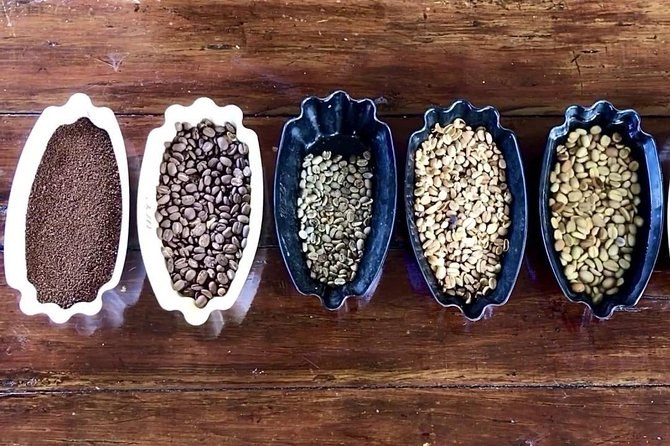
Screen size. After the parchment husk is milled off, green beans are sorted over screens, then by density, then by colour, then by hand on a belt. The largest screens make No. 1.
Bigger is not automatically better in the cup, but the sorting is what makes a lot consistent, and consistency is most of what you are paying for at this price. It is a mark of care rather than of flavour.
A coffee cherry normally holds two flat seeds facing each other. Occasionally only one develops, and it comes out round: that is a peaberry. It is separated at sorting because it behaves differently in the roaster, not because it is a higher grade.
Whether it tastes better is a matter of preference and of the roaster's skill. It is rarer, so it costs more. Try it at the tasting before you buy a bag of it.
This is where money is lost. The origin name is protected; the word "blend" beside it is not. A bag that says Blue Mountain blend may hold ten per cent of the real thing.
Reputable sellers state the percentage. If a bag does not, and the price is a fraction of what a certified bag costs, you have your answer. That is the single most useful thing to take from this page.
Almost all of the crop leaves Jamaica green and is roasted in the country that buys it. Green beans keep for far longer than roasted ones and travel better, so if you roast at home they are the better souvenir.
If you do not, buy roasted and buy recent. A bag roasted three weeks ago at any roast level beats a bag roasted six months ago at your favourite one. Ask for the roast date, not the roast profile.
The estates sell beans, and so does the Mavis Bank factory shop. Both put the money closest to the farm, which matters more than usual after the 2025 crop losses. The airport is convenient and rarely the best value.
Nobody publishes a shelf price in advance, at any of the three. So the practical approach is to taste at the estate, ask what is roasted and when, and buy the smallest bag that will get you home — then compare at the airport if you have time. What to ask at the tasting table.
Prices move with the crop, and the crop has moved sharply. That is the honest answer, and it is why this page names no figure it cannot stand behind.
What can be said is why it is expensive at all. The legal growing area is small. Every cherry is picked by hand in repeated passes, because they ripen unevenly. Over 80 per cent of the crop is exported and most of it goes to Japan. And the 2025/26 season lost roughly 40 per cent of its mature crop to a hurricane.
Melissa came ashore in western Jamaica on 28 October 2025 as a Category 5. The worst damage was in the west and the south, but about 40 per cent of the mature 2025/26 coffee crop was lost across St Andrew, Portland and St Thomas.
JACRA completed a $120-million recovery programme in March 2026, distributing seedlings, fertiliser and crop-protection materials across the Blue Mountain and High Mountain regions. The trees will take years rather than months. In the meantime, expect tight supply and firm prices. The harvest page follows it.
A short list, and any estate or factory shop will answer all of it without blinking. Asking is also the fastest way to find out whether the person selling knows the product.
Taste before you buy, which is what the tasting at the end of every tour is for. It is much easier to spend confidently at the counter when the cup is still in your hand.
Less than you think. A pound of this is a great deal of coffee, and it is at its best in the first month after roasting rather than the sixth. Two half-pound bags beat one large one for that reason alone.
If you are buying for other people, buy roasted and buy recent. If you are buying for yourself and you own a roaster, buy green: it keeps for a year, it travels better and it costs less per pound because the seller has done less work.
And leave room in the case. Foil bags puncture, so a hard shell or the middle of a suitcase is where they belong. Check what your own country allows you to bring in before you commit to a case rather than a bag.
Roasted coffee travels fine in a suitcase and better in a hard case, because the bags are foil and puncture easily. Green beans travel better still. Check your own country's rules on importing agricultural products before you buy a case rather than a bag.
And buy less than you think. A pound of this is a lot of coffee, and the pleasure of it is partly that you carried it down a mountain yourself. A Blue Mountains Jamaica coffee tour ends at the tasting table for a reason. Every one of them is on Blue Mountain Coffee Tours.
Where it grew. Only coffee from St Andrew, St Thomas, Portland or St Mary, between 3,000 and 5,500 feet, and certified by JACRA, may carry the name.
It is the largest screen size, sorted off the top. That is a mark of consistency rather than of flavour, and it is a grade within the origin rather than a separate coffee.
It is rarer, because it is the single round seed you get when only one of the pair develops. Whether you prefer it is a matter of taste, so try it at the tasting first.
Any proportion of the real thing. The origin name is protected; the word blend beside it is not. Read the percentage, and if it is not stated, assume it is small.
Nobody publishes a shelf price in advance, so compare. Buying at the estate does at least put the money where the crop grew, which counts for more than usual after the 2025 losses.
Roasted, unless you roast at home. Green beans keep and travel better, but they are only useful if you can do something with them.
Yes, Mavis Bank runs its own 45-minute visit on weekdays at US$8 for adults. You arrange it directly — the farms page has the hours.
From $180 per person
From $180 per person